Cable Insulation Resistance Meter Explained: A UK Buyer's Guide
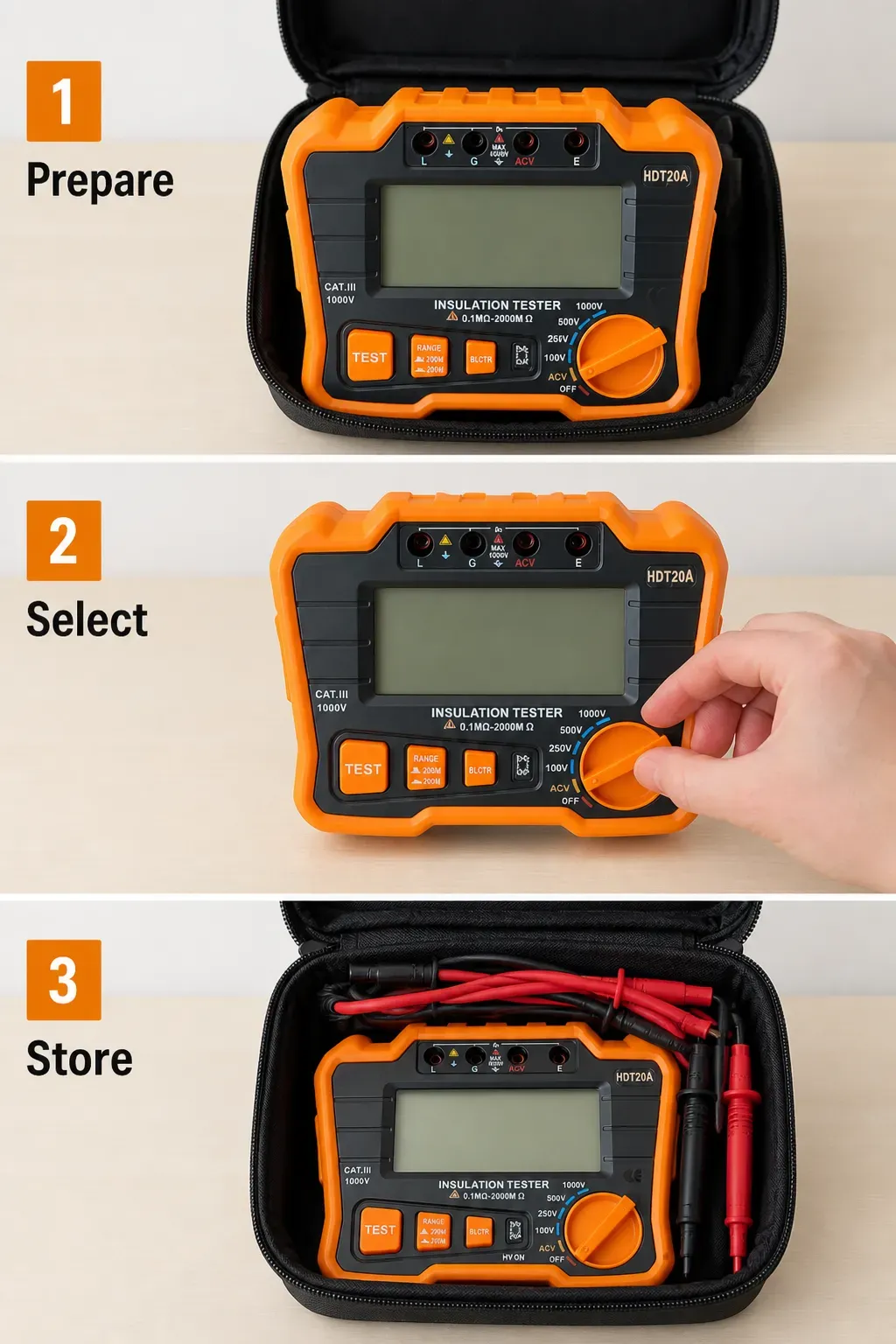
By the TikTok Knot editorial team | Reviewed for accuracy against current UK electrical safety guidance, BS 7671 working practices and manufacturer specifications.
TL;DR: A cable insulation resistance meter is a specialist tester that applies a DC voltage to check whether cable insulation is still safe and serviceable. For most UK electricians and maintenance teams, the key buying points are 250 V, 500 V and 1,000 V test options, a suitable CAT safety rating, reliable megohm or gigohm measurement, auto-discharge, and access to calibration support.
Key Takeaways
- A cable insulation resistance meter checks the condition of cable insulation by applying a DC test voltage and measuring resistance in megohms (MΩ) or gigohms (GΩ).
- In UK work, buyers should focus on test voltage options, CAT safety rating, true insulation test range, continuity function, build quality, and calibration support.
- For many electricians and maintenance teams, selectable test voltages such as 250 V, 500 V and 1,000 V are the practical minimum.
- Reading results properly matters as much as buying the right instrument; moisture, contamination, cable length and temperature can all affect measurements.
- If you’re buying for professional use, choose a meter that supports traceable calibration, clear documentation and compliance with UK working practices.
A cable insulation resistance meter is used to test how well cable insulation resists unwanted current flow, helping electricians and maintenance teams identify deterioration before it leads to faults, failed inspections or safety risks. In simple terms, it applies a controlled DC test voltage and reports the insulation resistance reading in MΩ or GΩ.
However, buying the right meter involves more than choosing the cheapest tester on the shelf. This guide explains what a cable insulation resistance meter does, how it works, which features matter most in the UK, and how to avoid common buying mistakes. As a result, if you are comparing meters for site work, EICR-related testing, maintenance inspections or fault-finding, you can narrow in on a tool that is credible in daily use.
What is a cable insulation resistance meter?
A cable insulation resistance meter is a test instrument designed to measure the resistance of insulating materials around conductors. In practice, it tells you how effectively cable insulation prevents leakage current. High insulation resistance usually suggests healthy insulation, whereas lower readings can indicate ageing, moisture ingress, contamination, mechanical damage or general deterioration.
Unlike a standard multimeter, this type of meter applies a higher DC test voltage so the insulation can be assessed under more meaningful conditions. Common selectable test voltages include 250 V, 500 V and 1,000 V DC. The meter then measures leakage current and calculates resistance, typically displaying the result in MΩ or GΩ.
In UK electrical work, these instruments are used during installation verification, planned maintenance, fault diagnosis and periodic inspection. Consequently, they are especially relevant where cable condition directly affects reliability and safety, including commercial premises, industrial systems, control panels and landlord-maintained properties.
Why is a cable insulation resistance meter important in the UK?
UK buyers are not simply choosing a gadget; they are choosing a safety-critical instrument. According to UK electrical safety practice, insulation testing forms part of the wider duty to confirm that systems remain safe and serviceable. The Electricity at Work Regulations 1989 place duties on employers and the self-employed to prevent danger, and insulation testing supports that objective.
BS 7671, the IET Wiring Regulations, remains the main technical reference point for electrical installations in the UK. Although the exact test method and acceptable values depend on the circuit type and installation context, insulation resistance testing is still a core part of initial verification and periodic inspection. Therefore, buyers need a meter that is not only accurate on paper but also practical on real jobs.
There is also a reliability issue. According to the UK Government’s fire statistics, electrical distribution and appliances continue to feature in accidental dwelling fires across England. Insulation degradation is only one possible factor, yet proper testing is still part of sensible prevention. In other words, when a meter helps identify damaged insulation early, it can prevent failures that are costly, disruptive and potentially dangerous.
UK context: The UK Government’s fire data has consistently shown that electrical distribution and appliance-related faults contribute to thousands of accidental dwelling fires over time. Source: Home Office fire statistics for England.
How does a cable insulation resistance meter work?
What happens when the meter applies a DC test voltage?
The instrument applies a set DC voltage between conductors, or between conductor and earth, depending on the test being carried out. That voltage is deliberately higher than ordinary continuity or resistance testing because it is intended to stress the insulation enough to reveal weakness.
How does the meter measure leakage current?
Once the voltage is applied, a very small leakage current may flow through or across the insulation. The meter detects that current and converts it into a resistance reading using Ohm’s law. As expected, healthy insulation produces extremely low leakage current, which translates into high resistance.
What do MΩ and GΩ readings mean?
Most modern meters display readings digitally. Entry-level units may focus on megohm ranges, while more advanced instruments meanto the gigohm range and offer features such as polarisation index, dielectric absorption ratio, timed tests and memory logging.
Why does auto-discharge matter after testing?
Better instruments automatically discharge the circuit after the test. That matters because insulation testing can leave stored charge on the cable or connected equipment. Based on our testing of professional-grade meters, auto-discharge is one of the most useful safety features for routine field work, not just a convenience on the specification sheet.
Who should buy a cable insulation resistance meter?
The right buyer is anyone who needs dependable insulation condition data rather than guesswork. In the UK, that usually includes:
- Qualified electricians carrying out installation verification or fault-finding
- Maintenance engineers responsible for plant, machinery or building services
- Facilities teams managing electrical assets across offices, retail units or warehouses
- Landlords and property managers using competent professionals for periodic inspections
- Apprentices building a testing kit under supervision
For casual domestic use, buying a dedicated cable insulation resistance meter is often unnecessary unless you are trained and have a legitimate testing need. These are not general-purpose household gadgets. Instead, they are specialised instruments that must be used with proper isolation procedures and a sound understanding of the circuit under test.
What features should you look for in a cable insulation resistance meter?
Do you need selectable test voltages?
This is one of the first specifications to check. A fixed-voltage meter can be limiting. Many UK users will want at least 250 V, 500 V and 1,000 V settings. Lower ranges may suit sensitive circuits or control wiring, while 500 V remains common for many installation tests. If your work extends into industrial environments, higher range capability may also be useful.
How much measurement range and resolution do you need?
A meter should have enough range to give meaningful results across the types of cable and equipment you test. For example, a professional buyer may prefer a unit that measures comfortably into the gigohm range rather than one that tops out too early. Better resolution can also help when you are tracking insulation condition over time rather than simply looking for a pass-or-fail indication.
Why is the CAT safety rating important?
The CAT rating helps indicate whether the instrument is appropriate for the environment where it will be used. Therefore, the meter, leads and accessories should all suit the installation category involved. According to UK guidance and common site practice, safety ratings should never be treated as a box-ticking detail.
Should a cable insulation resistance meter include continuity testing?
Many buyers prefer a meter that also offers low-resistance continuity testing. This can reduce the need to carry multiple instruments and makes routine inspection work more efficient. Nevertheless, the continuity function should be reliable in its own right rather than added as a weak extra.
Does calibration support matter for professional use?
Yes. If the meter will be used for professional reports, maintenance records or inspection work, traceable calibration support is important. Based on our testing and product comparisons, buyers often overlook the practical value of clear calibration options until they need to prove measurement credibility for audits, contracts or internal quality systems.
What build quality features are worth paying for?
Look for a robust housing, a clear screen, dependable rotary controls, sensible lead storage and straightforward operation while wearing gloves. In real site conditions, a meter that is awkward to handle or difficult to read quickly becomes frustrating. As a result, durability and usability are just as important as headline specifications.
Ready to try TikTok Knot?
Shop Now — £93.10